
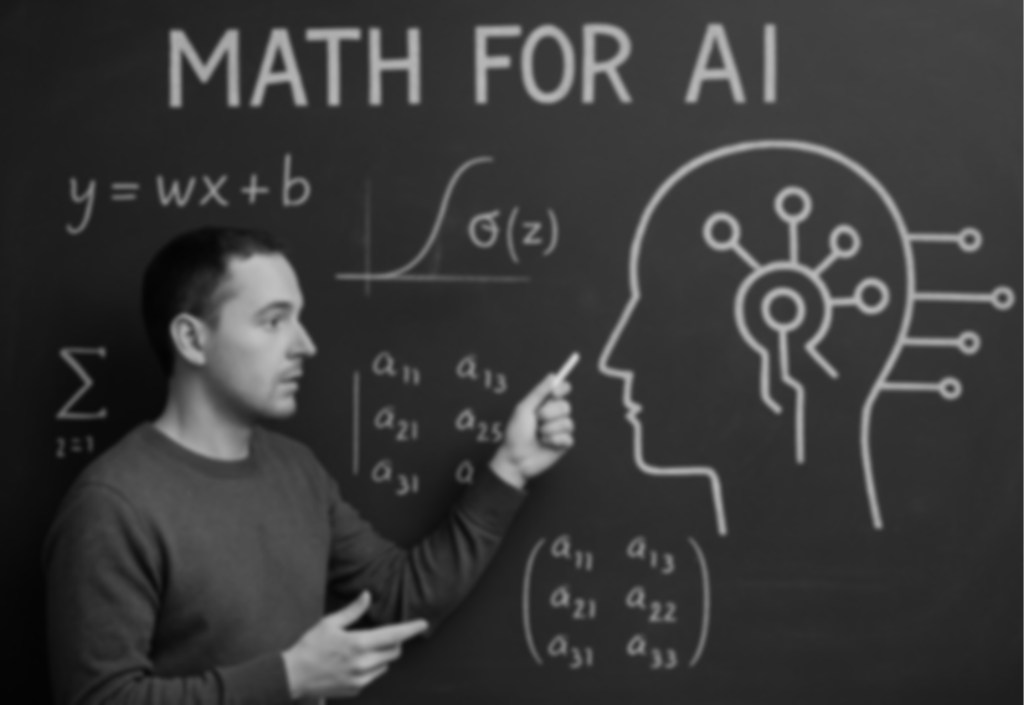
Your math background is a strong foundation for a career in AI, especially in areas like machine learning, optimization, and data science. Here are some ways to leverage it:
- Specialize in Applied Mathematics for AI
- Linear Algebra: Essential for neural networks and deep learning.
- Probability & Statistics: Key for statistical modeling, Bayesian inference, and generative AI.
- Optimization: Used in training AI models (gradient descent, convex optimization).
- Learn Programming & AI Tools
- Python (NumPy, Pandas, TensorFlow, PyTorch).
- Algorithmic thinking (data structures, complexity analysis).
- Implement mathematical models in code.
- Explore Theoretical AI Research
- If you’re inclined toward theory, explore AI ethics, information theory, or algorithmic learning theory.
- Become a Data Scientist or ML Engineer
- Use statistical modeling, predictive analytics, and AI-driven solutions in real-world applications.
What Math concepts are useful for each of 1-4?
- Specialize in Applied Mathematics for AI
Key Math Concepts:
- Linear Algebra → Used in neural networks, image processing, and embeddings.
- Vectors, matrices, eigenvalues/eigenvectors
- Singular Value Decomposition (SVD), Principal Component Analysis (PCA)
- Probability & Statistics → Essential for uncertainty modeling and decision-making in AI.
- Bayes’ theorem, probability distributions
- Markov chains, Hidden Markov Models (HMMs)
- Maximum likelihood estimation, expectation-maximization
- Optimization → Used for training AI models efficiently.
- Gradient descent, stochastic gradient descent (SGD)
- Convex and non-convex optimization
- Lagrange multipliers
- Learn Programming & AI Tools
Key Math Concepts:
- Discrete Mathematics → Helps with algorithmic thinking and complexity analysis.
- Set theory, combinatorics, graph theory
- Boolean algebra, logic
- Algorithmic efficiency (Big-O notation)
- Calculus → Used in deep learning for backpropagation and optimization.
- Partial derivatives, chain rule
- Jacobian and Hessian matrices (for higher-dimensional optimization)
- Probability & Statistics → Used in data preprocessing and analysis.
- Descriptive statistics (mean, variance, standard deviation)
- Confidence intervals, hypothesis testing
- Explore Theoretical AI Research
Key Math Concepts:
- Information Theory → Helps in understanding compression, entropy, and learning.
- Entropy, Kullback-Leibler divergence
- Mutual information, cross-entropy loss
- Graph Theory → Useful in probabilistic graphical models, network science, and knowledge graphs.
- Bayesian networks, Markov random fields
- Graph embeddings
- Measure Theory & Functional Analysis → Foundational for probability in infinite spaces and reinforcement learning.
- Lebesgue integration, probability measures
- Hilbert and Banach spaces
- Become a Data Scientist or ML Engineer
Key Math Concepts:
- Linear Algebra & Statistics → Used in data transformations and feature engineering.
- Principal Component Analysis (PCA)
- Regression analysis (linear, logistic, ridge, lasso)
- Probability & Hypothesis Testing → For making data-driven decisions.
- A/B testing, Bayesian statistics
- Confidence intervals, p-values
- Time Series & Signal Processing → Important for forecasting models.
- Fourier transforms, wavelets
- Autoregressive models (AR, ARIMA, LSTMs)
- Optimization → For hyperparameter tuning and model selection.
- Grid search, Bayesian optimization
What high school and middle school Math concepts are prerequisites for mastering these concepts?
If you want to master the advanced math concepts used in AI, you’ll need a solid foundation in middle school and high school math. Here’s how early math topics build up to the concepts needed for AI:
- Prerequisites for Applied Mathematics in AI
(Linear Algebra, Probability, Optimization, etc.)
Middle School (Grades 6-8)
✅ Arithmetic: Operations, fractions, decimals, percentages
✅ Basic Algebra: Variables, simple equations, inequalities
✅ Geometry: Shapes, angles, area, perimeter
✅ Probability Basics: Simple probabilities, counting principles
High School (Grades 9-12)
✅ Algebra I & II:
- Solving equations, factoring, exponents, logarithms
- Functions (linear, quadratic, exponential, logarithmic)
✅ Geometry & Trigonometry:
- Coordinate geometry (distance, midpoint, slope)
- Trigonometric functions (sine, cosine, tangent)
- Vectors (basic understanding)
✅ Pre-Calculus:
- Matrices and determinants (intro to linear algebra)
- Limits and rates of change (precursor to calculus)
- Sequences and series (useful for summations in AI)
✅ Probability & Statistics:
- Permutations & combinations
- Mean, median, standard deviation
- Probability distributions (binomial, normal)
✅ Calculus (if available in high school):
- Differentiation and integration
- Partial derivatives (helps for optimization in AI)
- Prerequisites for Programming & AI Tools
(Discrete Math, Algorithmic Thinking, Calculus, Probability & Statistics)
Middle School (Grades 6-8)
✅ Logic & Patterns: Logical reasoning, sequences, number patterns
✅ Intro to Functions: Understanding relationships between variables
✅ Basic Graphing: Plotting points on a coordinate plane
High School (Grades 9-12)
✅ Algebra II & Pre-Calculus:
- Functions and graph transformations
- Exponential and logarithmic functions
✅ Discrete Mathematics (if available in high school):
- Set theory (important for data structures)
- Graph theory basics (networks, shortest paths)
- Boolean algebra (foundation for programming logic)
✅ Calculus (if available in high school):
- Limits, derivatives, integrals
- Chain rule (used in AI optimization)
- Prerequisites for Theoretical AI Research
(Graph Theory, Information Theory, Functional Analysis, etc.)
Middle School (Grades 6-8)
✅ Number Theory Basics: Prime numbers, factors, modular arithmetic
✅ Patterns & Sequences: Fibonacci sequence, arithmetic sequences
✅ Basic Probability: Simple probability trees, expected values
High School (Grades 9-12)
✅ Algebra & Trigonometry:
- Complex numbers (important in Fourier transforms)
- Logarithms & exponentials (used in AI loss functions)
✅ Graph Theory (if available in high school math or CS electives):
- Understanding networks, nodes, edges
- Eulerian & Hamiltonian paths
✅ Statistics & Probability:
- Conditional probability & Bayes’ theorem
- Expected values and variance (key for AI uncertainty)
- Prerequisites for Data Science & ML Engineering
(Regression, Time Series, Optimization, etc.)
Middle School (Grades 6-8)
✅ Ratio & Proportions: Scaling and normalizing data
✅ Percentages: Understanding growth rates, percentages in statistics
✅ Data Interpretation: Reading graphs, tables, histograms
High School (Grades 9-12)
✅ Algebra & Pre-Calculus:
- Linear and quadratic equations (used in regression models)
- Logarithms (used in scaling data and ML loss functions)
✅ Probability & Statistics:
- Mean, median, mode, variance, standard deviation
- Correlation & regression (linear regression is key for ML)
✅ Calculus (if available in high school):
- Derivatives & integrals (for optimization in AI models)
- Partial derivatives (used in deep learning)
✅ Intro to Computer Science (if available):
- Understanding algorithms, basic programming
- Data structures (arrays, linked lists, graphs)
Key Takeaways
If you want to build a strong foundation for AI:
Start with Algebra and Statistics → These are the most important for AI.
Get comfortable with Functions & Graphs → Linear algebra and calculus depend on them.
Learn some Probability Early → Helps with AI decision-making.
If possible, take Calculus & Discrete Math in high school → These will make college-level AI concepts much easier.
 One-Zero